
The Ultimate Guide: How to Play Soccer and Master the Fundamentals
Soccer, globally known as football, is the world’s most popular sport for a simple reason: its beautiful blend of athleticism, strategy, and skill. Whether you are a parent trying to understand the basics or a young athlete just starting out, learning how to play soccer involves mastering both the rules and the fundamental techniques.
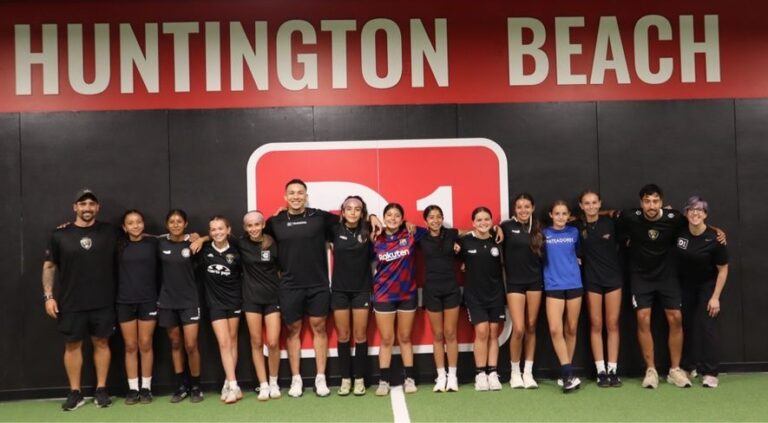
For aspiring players in Newport Beach, understanding the game’s core concepts is the first step toward high-level performance. Br Elite Soccer, a leading training academy in the area, emphasizes that foundational knowledge is key to building a successful career.
Discover How To Play Soccer in Huntington & Newport Beach
Part 1: The Essential Rules of How to Play Soccer
Before hitting the field, every player must grasp the basic structure and rules of the game. If you want to know how to play soccer, start with these basics.
The Field, Players, and Duration
The Pitch: Soccer is played on a rectangular field called a pitch. Key areas include the penalty box (or 18-yard box) and the goal box (or 6-yard box).
Team Composition: Each team has 11 players on the field at one time, including one goalkeeper.
Game Time: A standard match consists of two 45-minute halves, separated by a halftime break.
Key Rules to Know
No Hands (The Exception): Players (excluding the goalkeeper within their own penalty box) cannot use their hands or arms to control or move the ball. Using the shoulder is generally permitted.
Scoring: A goal is scored when the entire ball crosses the goal line between the goalposts and under the crossbar.
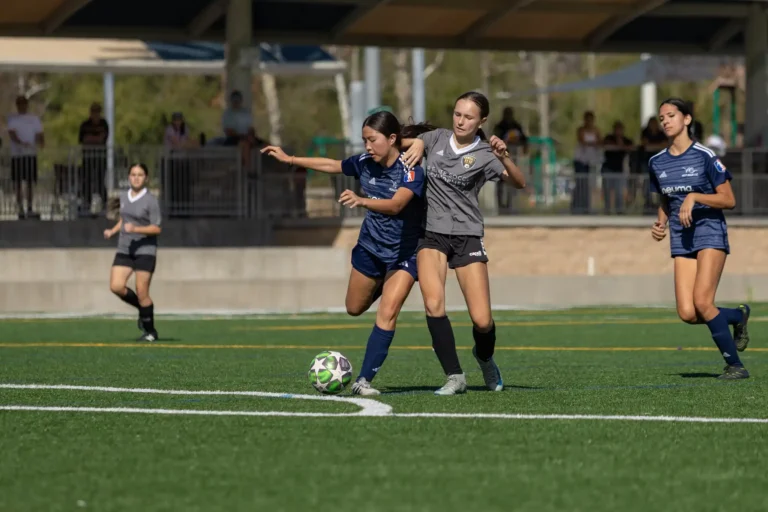
Kick-Ins/Throw-Ins: If the ball goes out of bounds on the sidelines, the opposing team restarts play with a throw-in. If it goes out over the goal line (last touched by the defending team), a corner kick is awarded. If last touched by the attacking team, a goal kick is awarded. Understanding these restarts is vital to know how to play soccer effectively.
Part 2: Mastering Foundational Soccer Skills
Knowing the rules is one thing; executing skills at game speed is another. Elite training for soccer focuses on automating these four fundamental techniques. Mastery of these skills is crucial for anyone learning how to play soccer.
1. Dribbling and Ball Control
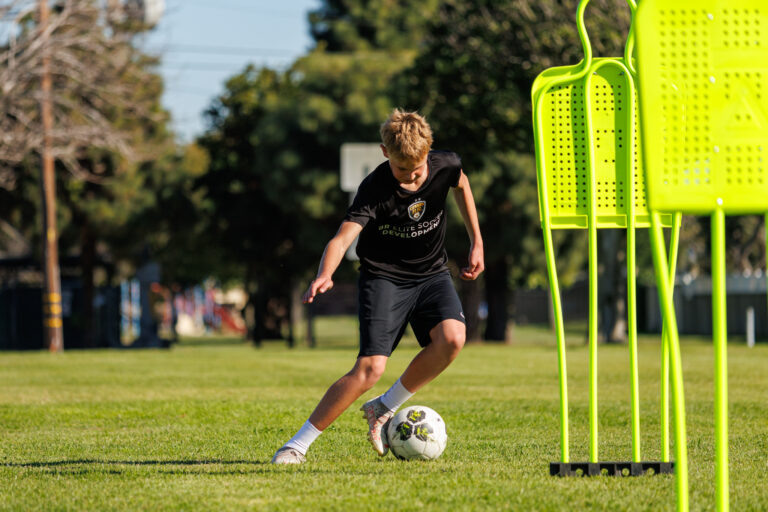
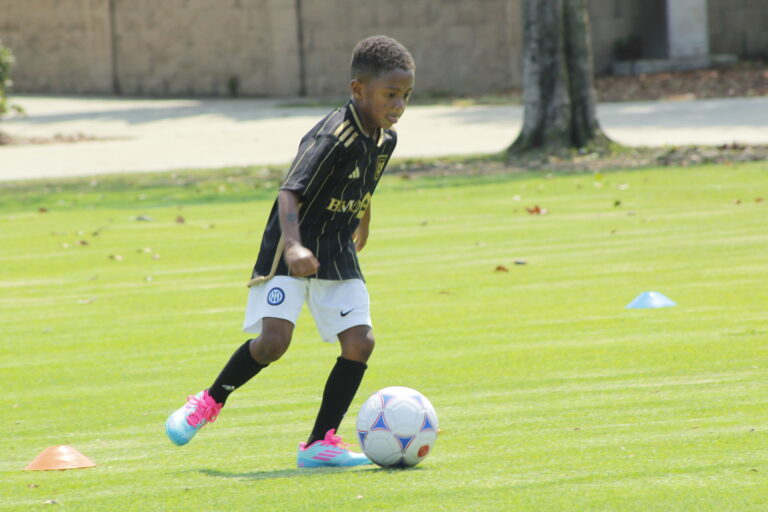
Dribbling is the art of moving the ball while maintaining close control. It is perhaps the most vital individual skill.
Key Technique: Use the inside and outside of the foot (the instep) to tap the ball gently, keeping it within arm’s reach. Avoid looking down at the ball constantly; learn to use peripheral vision.
The Objective: Keep the ball moving and protected from defenders. Our specialized youth soccer training programs ensure hundreds of touches per session to build this muscle memory.
2. Passing
Passing is the primary method of team movement and strategy. Accurate passing is the foundation of fluid play.
Short Passes (Inside of the Foot): Use the largest surface area of the foot for accuracy. Strike the ball in the center and follow through toward your target.
Long Passes/Crosses (Instep/Laces): For power, strike the lower half of the ball with the laces, leaning over the ball to keep it low.
Receiving: Use the inside of the foot to “cushion” the ball, reducing its speed upon impact to ensure a perfect first touch.
3. Shooting
Shooting requires a blend of power and precision. It is the decisive moment of any attacking move.
Power Shot: Strike the center of the ball with the hardest part of your foot—the laces. Lock your ankle and follow through towards the target.
Placement Shot: Often executed with the inside of the foot for accuracy, aiming for the corners of the goal.
Mental Toughness: Practice shooting under fatigue and pressure to simulate the intense moments in a match.
4. Defending and Tackling
Effective defending involves positioning, anticipation, and aggressive tackling when necessary.
Body Positioning: Always approach an attacker from the side (known as “forcing play”) to minimize space and prevent them from easily moving past.
The Tackle: Use the outside of the foot to cleanly poke the ball away, ensuring you do not make contact with the opponent’s leg, which would result in a foul.
Communication: A crucial, often overlooked element. Defenders must talk constantly to organize the back line.
Part 3: Why Specialized Training Accelerates Mastery
Learning how to play soccer through team practice alone can only take a player so far. By the time players reach their competitive teens, the gaps in individual technique become major liabilities. This is where personalized training becomes essential for success in Huntington Beach.
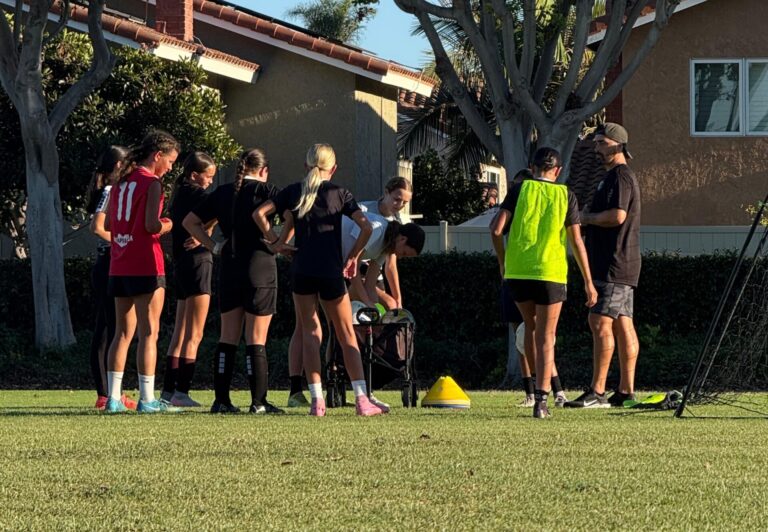
Br Elite Soccer specializes in breaking down the game into teachable, repeatable steps through individual and small-group instruction. This is the fastest way to truly master how to play soccer.
Personalized Feedback: A dedicated private soccer coach can immediately correct technical flaws. This targeted feedback accelerates learning far beyond what a large team coach can provide.
Weakness Elimination: Programs are designed to focus on the player’s specific deficiencies, such as developing the weaker foot or improving aerial control.
Position-Specific Work: Whether you need intense goalkeeper training near me or detailed striking instruction, our high-performance sessions offer the expertise needed to excel in your specific role.
The difference between a good player and a great player is the quality and consistency of their specialized training for soccer.

Your Next Step in Huntington & Newport Beach
If you are committed to mastering the art of the game, formal, structured youth soccer training is the answer. Br Elite Soccer offers programs that bridge the gap between basic play and elite performance.
Private Soccer Training Near You
It is time to elevate your fundamentals and turn practice into power. Visit our website to explore our private soccer lessons and see how Br Elite Soccer in Huntington Beach can transform your game.